
The Buyer Has Left the Funnel and Sent an AI Agent instead.
Your next customer may never see your ad, visit your website or appreciate your gently pulsating brand gradient. What happens to marketing when software starts making the shortlist?
For the last hundred years, marketers have worried about reaching the customer.
That was apparently too straightforward.
The customer now has an agent.
The agent has access to every competitor, every review, every price, every product specification and every regrettable claim your company has made since 2007. It does not get tired. It does not become emotionally attached to your logo. And it has never once clicked an ad because the people in the stock photo looked unusually collaborative.
Welcome to the next delightful complication in marketing.
AI is no longer just helping companies make things. It is beginning to help customers choose things.
And that changes considerably more than the media plan.
Quick Answer: How Are AI Agents Changing Brand Strategy?
An AI purchasing agent is software that can research, compare, recommend and increasingly purchase products or services on behalf of a customer. This shift, often called agentic commerce, means brands must now communicate with two audiences: machines that need clear, consistent and verifiable information, and humans who still choose based on trust, emotion and preference. The agent may create the shortlist. The brand still has to make someone desire it.
First AI Became the Copywriter. Now It Is Becoming the Customer.
The first wave of marketing AI was mostly about production.
Write this email. Resize this ad. Summarize this research. Create a ton of social posts about a webinar nobody attended.
The promise was efficiency. Marketing would become faster, cheaper and capable of producing more content than any human being could possibly want.
Done. Mission accomplished.
We now have more content than at any point in human history, and much of it reads like a refrigerator explaining digital transformation. As we explored in Why AI Is Making Marketing Sound the Same, increasing the volume does not necessarily increase the value.
But the next wave is different.
AI agents are beginning to work on behalf of customers. They can research categories, compare options, evaluate claims, check reviews, find pricing, narrow choices and increasingly take action.
Google has already introduced technology designed to support agent-led shopping and checkout. Adobe is openly discussing a future in which marketers serve both human and “agentic” audiences. BCG says agents will increasingly influence how customers discover, evaluate and buy.
This is not a theoretical panel at a technology conference anymore. The infrastructure is being built while most marketing departments are still debating whether ChatGPT should be allowed to write the newsletter.
Your Funnel Assumes a Human Is Inside It
The traditional customer journey is built around a comforting assumption: somewhere out there, a person is slowly moving through it.
First they become aware. Then they show interest. Then they consider. Then they convert. Then everyone in marketing receives a colorful chart proving this happened exactly as planned.
AI agents are unlikely to respect the chart.
A person may ask an agent to identify the best software platform for a 500-person company, compare three prenatal vitamins, find a hotel for a wine-country weekend or recommend a cybersecurity provider that meets a specific set of requirements.
The agent can conduct the early stages of that journey without ever seeing your campaign, admiring your website or downloading your 38-page guide to “unlocking transformational value.”
In B2B, an AI agent may compare vendors, assemble a shortlist and summarize the strengths and weaknesses of each before a human buyer joins the process.
Your six-month nurture sequence may soon be compressed into fourteen seconds and a table.
Somewhere, a demand-generation dashboard just felt a disturbance in the Force.
The New Shortlist Happens Before the Human Arrives
This is the shift CMOs need to understand.
For years, marketing fought to get onto the customer’s shortlist.
Now marketing must increasingly get onto the agent’s shortlist first.
And agents evaluate brands differently than people do.
They look for clarity. Consistency. Evidence. Availability. Compatibility. Reviews. Pricing. Independent validation. They compare what you claim with what the rest of the market says about you.
They are very good at gathering information.
They are less impressed by a manifesto video featuring a satellite, a child looking through a telescope and a voice-over announcing that humanity stands at a crossroads.
This does not mean creativity is dead.
It means creativity may no longer be doing the same job at every stage of the decision.
The agent determines whether you deserve consideration.
The brand determines whether a human ultimately cares.
Machines Need Clarity. Humans Need Meaning.
The brands that win this new era will have to communicate with two very different audiences.
The first is the machine.
It needs to understand what you do, who you are for, why you are different and whether your claims can be supported. If your positioning changes from page to page, if your product language is vague, or if your website requires a detective and three internal meetings to explain what you sell, the agent will not appreciate the mystery.
It will simply recommend somebody else.
The second audience is the human being.
Humans still choose based on trust, identity, emotion, aspiration and instinct. We want to feel confident. We want to avoid regret. We want to believe a company understands us. Occasionally, we want to buy the thing in the nicer box even when the ingredients are almost exactly the same.
This is where brand still does what brand has always done.
It turns information into preference.
An agent can tell someone which product checks the most boxes.
It cannot fully explain why one company feels like the right company.
That space between “best match” and “I want that one” is where brand lives.
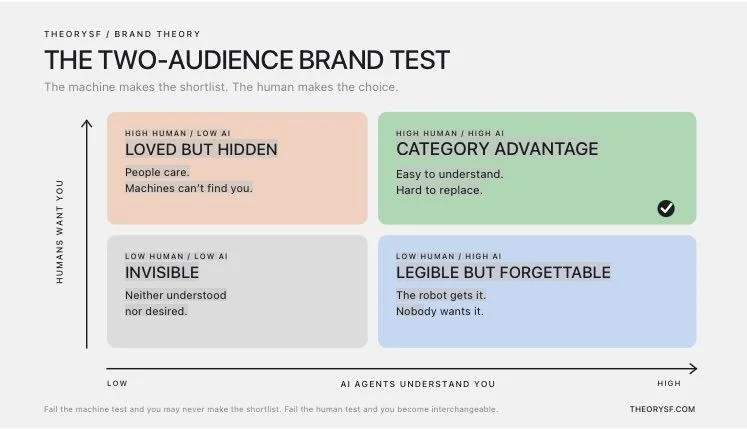
Optimize for the agent. Differentiate for the human.
Machine-Readable Is Not the Same as Memorable
There is already a predictable response forming inside marketing departments:
“We need to optimize for agents.”
Correct.
And dangerous.
Because marketing has a long history of discovering a new system and immediately contorting itself into whatever it believes the system wants.
We did it with search engines. We did it with social algorithms. We did it with performance media. We are doing it now with generative AI.
The result is usually the same: more optimization, more sameness and a vast amount of content explaining five ways to do something nobody was trying to do.
If every company optimizes for the same agents using the same data, the same structures and the same language, every company becomes perfectly legible and completely interchangeable.
Congratulations. The robot understands you.
Unfortunately, nobody remembers you.
Machine readability matters. But it cannot become the whole strategy.
Your brand must be easy for an agent to understand and difficult for a human to confuse with anyone else.
That is a much higher bar.
This Is Not the Death of Brand
Every new technology produces the same obituary.
Television will kill radio. Digital will kill television. Performance marketing will kill brand. AI will kill search. The metaverse will kill pants.
Most of these predictions confuse a change in behavior with the extinction of a human need.
People will still want reassurance. They will still trust some companies more than others. They will still use brands as shortcuts for quality, identity and confidence. They will still make irrational choices and then construct impressively rational explanations for them.
Humans are adorable that way.
Agentic buying does not eliminate brand. It raises the cost of having a weak one.
If your company has no clear position, no meaningful differentiation and no evidence supporting its claims, the agent will expose that quickly.
If your brand is nothing more than a logo sitting on top of the same promises every competitor makes, the human will expose it eventually.
The future will be particularly unkind to companies that are neither easy to understand nor interesting to choose.
Which, unfortunately, describes a surprising amount of B2B marketing.
CMOs Now Have Two Customers
The practical implication is not that CMOs should launch a Department of Robot Marketing and appoint a vice president of pleasing the algorithm.
Please do not do that. LinkedIn has suffered enough.
But marketing leaders should begin treating agent comprehension as part of brand strategy, not merely another technical assignment for SEO or e-commerce. AI search visibility is already a positioning problem. Agentic buying simply moves that problem farther down the decision journey.
Start with five questions:
1. Can an AI agent clearly explain what makes us different?
Not what you do. What makes you meaningfully different.
If the answer sounds identical to three competitors, the agent is not confused. Your positioning is. That is the same courage gap that causes so much B2B technology messaging to disappear into the category.
2. Are our claims supported outside our own website?
Agents will not rely exclusively on what brands say about themselves, which is sensible because brands have been “revolutionizing the industry” for nearly twenty years and the industry remains suspiciously unrevolutionized.
Reviews, customer evidence, analyst coverage, earned media, expert commentary and credible third-party mentions will matter enormously.
3. Is our story consistent everywhere?
If the website says one thing, sales says another and the product pages appear to have been written by seven departments negotiating a hostage release, you are creating weak signals.
Consistency is no longer merely a brand-management virtue. It is machine comprehension.
4. Are we creating preference—or merely supplying information?
Agents can organize information more efficiently than your content hub ever will.
The brand must do something the agent cannot: create a point of view, an emotional advantage and a reason to care beyond the comparison table.
5. Would anyone notice if a competitor said exactly the same thing?
This remains the most useful test in marketing.
Remove the logo. Change the color. Could the campaign belong to somebody else?
If yes, an AI agent may still understand it.
But a human being will have no reason to remember it.
The CMO’s Role Just Became More Important
CMOs are already under pressure to adopt AI, reduce costs, increase output and prove growth—preferably before the next executive meeting.
According to Gartner’s 2026 CMO Spend Survey, companies are putting 15.3% of their marketing budgets into AI, while only 30% of CMOs say their organizations are ready to scale it effectively.
That is a great deal of money being spent to discover that buying the tools was the easy part.
The difficult part is deciding what they should do, what the brand should stand for and where human judgment still creates an advantage.
AI can generate options.
It cannot decide which future your company should bet on.
It can optimize a message.
It cannot give a company the courage to say something its competitors would never say.
It can help a brand become easier to find.
It cannot make that brand worth finding.
That remains a leadership job.
Make the Robot Understand You. Make the Human Want You.
The future of marketing will not be human versus machine.
It will be brands learning how to create meaning across both.
Machines will increasingly filter the market. They will gather evidence, compare choices and eliminate weak options with breathtaking efficiency.
Humans will still decide what feels trustworthy, distinctive and worth bringing into their lives or businesses.
The agent may control the shortlist.
The brand will still have to create desire.
So yes, structure your information. Clarify your positioning. Strengthen your evidence. Make your company easy for AI to understand.
Then do the part marketers keep trying to optimize away.
Be interesting.
Because your next customer may be a human.
But the first customer you have to convince might not be.
Frequently Asked Questions About AI Agents and Brand Strategy
What is an AI purchasing agent?
An AI purchasing agent is software that can research products or services, compare alternatives, evaluate evidence, recommend options and sometimes complete a transaction for a customer. In B2B buying, an agent may also assemble vendor shortlists, compare capabilities and summarize risks before a human buyer enters the process.
How do AI agents choose which brands to recommend?
AI agents evaluate available information such as product details, pricing, reviews, customer evidence, third-party coverage, availability and compatibility with the customer’s requirements. Brands with clear positioning, consistent information and credible market signals are easier for agents to understand and recommend.
Will AI agents make branding less important?
No. AI agents may make branding more important by separating functional qualification from human preference. An agent can identify which brands meet the requirements, but people will still use trust, emotion, identity and perceived value to make many final decisions. Machines narrow the field. Brands create desire.
How should CMOs prepare for agentic commerce?
CMOs should make their positioning clearer, ensure product and company information is consistent, strengthen third-party evidence and audit how AI platforms describe the brand. At the same time, they must continue building a distinctive point of view and emotional advantage. Being understandable gets a brand considered. Being meaningful gets it chosen.
